

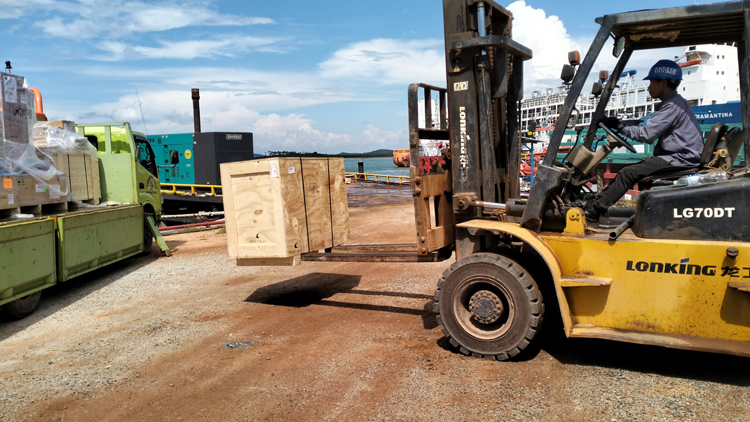
Loading and Unloading Process
The loading and unloading process at the port or shipyard is a series of long processes for shipping goods from one port to another. This process includes stevedoring, cargodoring, and receiving/delivery activities.
Introduction to Stevedoring: The Process of Loading and Unloading Ships
Stevedoring requires special skills and considerable experience in operating heavy equipment. A stevedore must also have strong physical abilities because the job is very demanding. In addition, stevedoring also requires good coordination between the ship's captain, shipping company, and port officials.
Basically, stevedoring is divided into two types: conventional stevedoring and container stevedoring.
Conventional stevedoring is a type of stevedoring that transports goods in the form of conventional cargo such as raw materials,
timber, or building materials. While container stevedoring is a type of stevedoring that transports goods in the form of containers.
Container stevedoring has become more popular in the last few decades. This is due to the increased use of containers as a means of transporting goods.
Container stevedoring requires more technical and organized skills because containers have standard sizes that must be considered and arranged properly.
The role of stevedoring in the maritime industry is very important because in this process,
a stevedore is responsible for the safety and speed of the loading and unloading process of goods at the port.
If the loading and unloading process is not done properly and carefully, it can cause damage to goods, ships, or even injure workers.
In addition, stevedoring can also affect the productivity and profits of shipping companies.
In recent years, technology has also helped the development of stevedoring. New equipment and software such as smart transportation systems,
warehouse management software, and supply chain management software can help improve the efficiency of the loading and unloading process.
An example of the use of technology in this case is by implementing Container Crane (CC), Harbor Mobile Crane (HMC),
and Rubber-Tyred Gantry Crane (RTGC) to increase loading and unloading productivity.
Overall, stevedoring is a very important job in the maritime industry. It requires specialized skills, experience, and strong physical abilities.
With the latest technology, stevedoring can become more efficient and can help increase the productivity and profits of shipping companies and freight forwarders.
Lily and 4 people like this


Perkasa Inovasi
Personal view of the author, and just info for readers.
Leave a Reply